Showing posts with label tarot. Show all posts

Saturday, 15 June 2013

My Top Three Tarot Decks and What I Use Them For

I have quite a few decks by now, but still there are a few firm favourites that I use most regularly. Some other time, I'll share some of my more unusual decks with you, but for today, I thought I'd introduce the decks I use most often. Decks do tend to have a character, so they are suited to different kinds of readings, much as different friends will give you advice with a different tone or flavour.


Deck Number 3: The Gilded Tarot


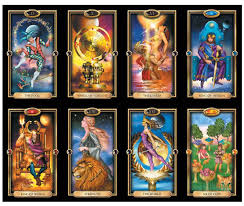
This is my favourite Rider-Waite based deck. It's beautiful and luminous with jewel-like colours. In terms of readings, this is a good one for straight talking. I always know if someone chooses this one (I usually give querents a choice of decks), then they need some straight-up advice. It's also quite easy to read, as the images are pretty clear and representative, so it's good for face-to-face readings as the querent can see I'm not just making it up or going from hunches.

Deck Number 2: The Druidcraft Tarot

This deck, fusing druidry and wicca, is gorgeous in a more gentle, less showy, way than the Gilded. I find it works well for both practical and spiritual questions. I particularly like the re-presentation of The Lady and The Lord for the Empress and Emperor, and found that the pagan sensitivities in this deck have added to my general understanding of the cards. Querents generally respond well to the gentle images on these cards, although they are huge and difficult for most people to shuffle (I turn them 90 degrees and shuffle them lengthwise).

Deck Number 1: Songs For the Journey Home

I love this unusual round deck. I find it beautiful and also incredibly gentle and supportive in its readings. It's good for any topic but works particularly well with emotional and psychological issues . This is a really special deck to me; I was fortunate enough to meet and have a reading with its illustrator. It's a non-traditional deck in many ways - the suits and court positions are renamed, as are many of the Majors, often revealing a slightly different slant on more 'standard' decks. Those who choose it often are in need of its warmth and non-judgmental approach to their concerns. I also find for personal readings it's great for pointing out the things I'm ignoring. Finally, it's a very woman-centred deck (as are many of the round decks - rejecting the black/white opposition of upright/reversed seems to be a feminist approach, interestingly).

So there you have it - the straight-talking Gilded, the pagan-themed Druidcraft and the warm and supportive Songs - my top three decks for reading.

Saturday, 18 May 2013

Reading: revisiting an abandoned project

As a writer, I have various bits and pieces of ideas and half-completed things lying around and there's this children's project which I've been poking at for a while now. I had a complete first draft, then really shifted things around (added two new main characters, changed the perspective, constructed a new setting - no small thing) but failed to finish that rewrite. So, here I am with an okay-but-not-outstanding first draft and a half-completed rewrite. Do I return to that rewrite? Start fresh using some of the same ideas? Draw a line under it altogether? This seemed a good question to ask the beautiful Druidcraft deck.

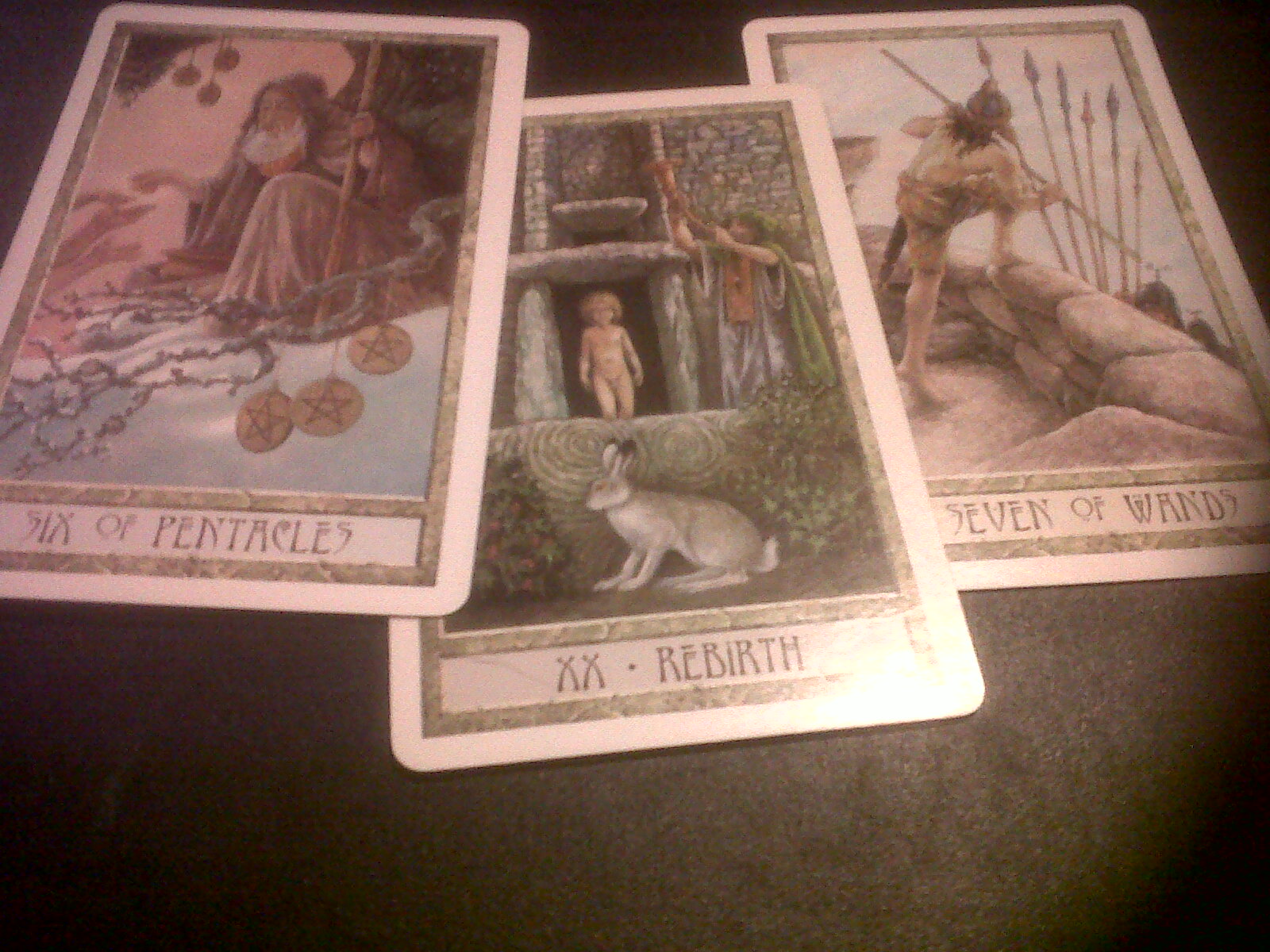
It presented me with the following three cards:
What is the best course of action to take? Six of Pentacles
What is the likely outcome of this course of action? Rebirth
What have I been overlooking? Seven of Wands

The Six of Pentacles is about generosity and giving. As a Pentacle, it's also about work and there is no hint of a new start or going back to the beginning - and of course, as a Six, it's a good distance along the path of the minors, reminding me perhaps that I have already gone quite some way with this project.

The card of Rebirth is more traditionally Judgement, but the representation here is much more clearly about entering a new phase, rather than the ending which is quite clearly connoted in the traditional, Christian-influenced presentation of the day of Judgement. Maybe completing a new version of this story would help me shift up a gear in my (fiction) writing?

My final card, the Seven of Wands, is a rather familiar card - I've been getting this one quite a bit recently. This is always a card about determination and persistence. If I'm honest (and why not be here, right?), I struggle to keep focused on the writing I want to do. I've been quite successful of late in getting writing work in terms of educational materials and teaching resources, but it's very easy to neglect the fictional stuff which I want to write but which (at the moment) no-one is paying me to do. Maybe this card is here to remind me to stand my ground and defend my fiction writing against the other pressures on my time that threaten to push it out. Otherwise, I can't keep claiming that it is what I really want, right?

Sunday, 28 April 2013

W: World Tree Spread using Wildwood Tarot

I'd like to occasionally feature actual readings on this blog, so I thought I'd try out this spread from the Wildwood Tarot book, as I haven't used it before and it looks like an interesting one. My work life is somewhat complex at the moment, so I've focused on that for this spread which the book describes as idea for situations that require a broad and comprehensive overview.

Position 1: Roots - The Knight of Bows, Fox (Knight of Wands)
Position 2: Branches - 7 of Vessels, Mourning (7 of Cups)
Position 3: East - The Knight of Arrows, Hawk (Knight of Swords)
Position 4: West - 11 The Woodward (Strength)
Position 5: South - 7 The Archer (The Chariot)
Position 6: North - The Queen of Bows, Hare (Queen of Wands)
Position 7: The Way Through the Woods - 2 of Vessels, Attraction (2 of Cups)
Position 8: The Wisdom of the World Tree - drawn only after reading the other cards

The first thing I notice about this spread is the patterns within it: 2 Bows court cards, 2 Vessels minor cards, 2 Knights, 2 majors, no Stones (Pentacles). In a spread about work matters, you could reasonably expect to see earth element cards like Stones or Pentacles. I think the fact that there aren't any here tells me that although I'm asking about work, this is not a mundane work-related question, but it's about what work represents for me in terms of my very essence and identity (the Bows), how I feel about work (the Vessels) and my stage in terms of life's journey (the majors and the Knights both suggest - in broad terms - being on the brink of something, being young in experience).

Taking the cards one by one more systematically now, I see that the Roots position answers "What is the root of the issue" and the Fox is, unsurprisingly, about cunning and being a good hunter. The book says "Determination leads you to success but sometimes at personal cost. Your life may change or enter a different path at any moment." I feel that this is about the struggles I'm having with finding the time and energy to solicit new work. I embarked on a freelance career almost a year ago, and have not branched out enugh in terms of finding new sources of work. This, I think, is the Fox's message to me: hunt more widely; work does not just come to you.

The Branches position has the question "What are the possibilities of the issue?" and I am somewhat dismayed to see the 7 of Vessels here, with its keyword of "Mourning". But then, reading the book's description of the card, it is not about loss (as I feared), but about mourning in the proper, most appropriate way. In some ways, I am damaged by my working past (the last situation which I left was not a positive experience), so perhaps the message here is that my new (and yes, although it's been almost a year, it is still very much new!) situation will be healing for me, and help me to mourn what I feel I lost.

The East position's question is "What do you take with you?" and the Hawk's answer is clearly about quick thinking and good ideas, which was certainly a reason for going freelance where I could work with my own ideas instead of toeing the line of others' ideas that I increasingly frequently didn't agree with. The book emphasises swiftness and subtlety and, as an Arrows (Swords) cards, this is related to the intellect, so I am happy to see that I can continue to create opportunities for myself that offer mental stimulation and challenge.

The West's position asks "What do you leave behind you?" and although on the surface, leaving The Woodward (traditionally Strength) behind may seem like a bad thing, I'm seeing this as leaving behind the need for so much strength, patience and dogged perseverance. In other words, this is a reassurance to me that I have taken the right step in leaving steady and secure employment that was literally driving me crazy.

The question in the South is "What do you hope for", and The Archer (or Chariot) in this position is perfect. The Archer rules her own destiny. Accompanied by her hunting dogs, she makes her own way in the world and is reliant on no-one else for her food or her wellbeing. Quite. The imagery of the bow (allied with wands  - fire - in this deck) and arrow (associated here with swords - air) perfectly sums up the nature of my work, which requires creativity and intellect above all else.

The North addresses the issue of "What you fear", and the Hare seems a little odd here, as the Queen of Wands often represents business success and strong interpersonal links. Am I afraid of success? Ouch. I have been fighting many low-level health issues lately that have reduced my energies and made it very difficult to get on with what I need to, and I have felt at times like I'm almost sabotaging myself by being unable to work as much as I should. Hmmm. I am aware that procrastination can be about fear of really trying in case it's not good enough. Maybe there is an element of that in there. The cards are pretty good at drawing out what you don't always want to acknowledge...

The Way Through the Woods, answering "What enables you to engage with the issue?" also seems strange to be the 2 of Vessels (or Cups), so often a card of new love. Two things sprung quickly to mind: I need to love what I'm doing (so that is perhaps a way to help me carve out projects that I'll want to work on), and my husband can help me. I'm certainly already aware of how much his belief in me and support of me enables me to do mad things like leap into freelancing, even though that has meant risking our family's financial security (I'm the main earner here). Looking at the book meanings for this card, this deck seems to emphasise that spark of attraction as being instinctive, intuitive and natural, so maybe this is a message to use my intuition more in figuring out my workload and finding work.

And finally, The Wisdom of the World Tree - the hidden wisdom of the issue - is revealed to be the Ten of Stones, Home (10 of Pentacles). So much for no stones/earth/pentacles - and what a lovely conclusion to have to this reading! If I had any remaining doubts about the sanity of my choices (and I do; I'm not always sure how we'll meet the bills each month, but so far we always have...), this is the card to allay them. Tens always represent a kind of conclusion to the suit's journey, so the 10 of Stones is about a place of security, safety and love - whether that's a literal place or a figurative, mental place. The card reminds me that security is what most concerns me, but it also reassures me with its lovely calming depiction of home. And home for me has only positive connotations, I am fortunate enough to be able to say. We may not have all the latest material crap, but we are rich in terms of our relationships.

The Wildwood tarot is gorgeous, by the way, and highly recommended, especially if you are a pagan. It uses animals and birds for court cards (as you've seen!) and woodland archetypes for the Majors, and is beautifully painted by Will Worthington.

Note for the curious: until the end of August 2012, I worked full time as a middle manager in a college for 16-19 yr olds. When a restructure due to funding cuts arrived, I opted for redundancy to build on my writing career, having published a textbook and several teachers' resources, and contributions to various teaching websites. I now teach part time on a supply basis and am working on various educational writing projects, as well as some writing projects which are more about personal satisfaction but may one day lead to more pubishing (such as this blog: I'd love to write on tarot and spirituality; I also have various children's stories languishing on my hard drive which I hope could one day become books). My struggle is balancing the work that I know will pay (teaching, writing teaching resources) with the work I want to break into but doesn't yet have as clear a market. I do enjoy the educational writing, and the teaching, but don't want that to be all of me, if that makes any sense at all.

I'd welcome any further insights or comments on my reading :)
Tuesday, 23 April 2013

T: Tarot - some beginners' resources


I've seen a few comments on my tarot-themed posts from people who have cards but don't really use them or aren't sure how to start, so I thought I'd share a few ideas for learning to work with them.

Joan Bunnings, Learning the Tarot

This is acknowledged as one of the best tarot learning methods, adopted as course book by the Tarot Association of the British Isles. The book focuses on keywords for each card, showing you how to combine these with positional meanings (within a spread, each location will have a particular meaning or theme) and with other cards to produce an overall story. In an incredible display of generosity, Bunnings has made her book freely available online. Please don't make the mistake of thinking this means it's worthless: it's actually invaluable.

Tarot Association of the British Isles (TABI)

Assuming you are in the UK, TABI are fantastic, with a lively forum, an excellent beginners' course and mentoring for more developed readers. You can also join their team of readers providing free readings via the website, which is a brilliant way to hone your skills. (If you're in the USA, the ATA - American Tarot Association - seems to be an equivalent, although of course I have no personal experience of them).

Teresa Michelsen, The Complete Tarot Reader: Everything You Need to Know from Start to Finish

This book is as comprehensive as the subtitle sounds. It's also very detailed, going way beyond the basics without requiring any prior knowledge.


I'll feature more in-depth reviews of decks and books as the blog develops, so there will also be something here for the more experienced reader. If that's you, I'd also recommend checking out my blogroll, as there are several good tarot blogs there. 

Monday, 22 April 2013

S: Symbols


The language of symbols is important to me in lots of ways. Obviously, as a Tarot reader, I need to understand and interpret the cards using a range of symbols, and also spells and visualisations often work by symbol, making use of the associations we have with things. In my more mundane life, though, I am an English teacher and work a lot with both language - which is a system of symbols - and literature, which relies heavily on our symbolic literacy.

Now, as an adult, I find it amusing to look back and think how much I always loved moons, hares and green men. Now, as a pagan, I see my attraction to these images as evidence that I was always drawn to the pagan path. Both the moon and the hare are goddess symbols, while the green man is associated with Cernunnos, Herne, Pan, Robin Hood and/or Robin Goodfellow: all lords of the forest.

How much richer our lives can be when we allow ourselves to connect with the language of symbols! Symbolic communication can be deeper than communication using words, since it can connect directly to the subconscious without requiring the medium of language which is, essentially, an abstraction.

Tuesday, 16 April 2013

N: Negative cards, negative readings

Traditional Death cards are NOT cuddly!
As a tarot reader, you never want to give people negative readings and there are, of course, some cards which seem to have a life of their own in the popular imagination: Death being particularly notorious. And however much, you have a nice little spiel ready about 'change' and physical death being unlikely and often it being a necessary and ultimately positive change, people still tend to blanch when they see that card.

This is one of the reasons that most of us don't do those 'does he love me?/ will I get married?' questions. With a yes/no question, there's usually a preferred response - and one that the querent [person having the reading] doesn't want to hear. Asking 'what can I do to bring about...?' or 'why hasn't x happened?' gives the  querent possibilities and doesn't render them mere victims of fate, waiting around passively for something to happen to them. It also makes a purely negative response far less likely.

Friday, 12 April 2013

K: Kings and Queens, Knights and Pages: The Tarot Court

The Tarot court cards are often those that we find hardest to interpret. A 'traditional divinatory' approach would often limit them to signifying people with specific physical appearances, based on the suit. Since modern Tarot is much more focused on self-development than prediction, "you will meet a dark-haired, dark-eyed man" is rather less than helpful.

There are now various established systems for reading court cards, and most readers will use a combination, selecting the most appropriate interpretation for each reading specifically. Many of these use some kind of system of meaning for the court position (i.e. there is a meaning for the 'kingness' of a card), which you combine with the suit drawn. This can be based on qualities associated with the character of a King (e.g. mature masculinity), Queen (mature femininity), Knight (relative immaturity - a teenage or adolescent kind of energy) or a Page (childhood innocence). Some readers will also assign an element to each of the four courts, and read each drawn court card as an interaction between the court position's energy and the energy of the suit (e.g. the King of Pentacles could be seen as Air of Earth).

I find that the system I use depends more on the deck than on anything else. Some decks change the court labels for different people (e.g. Knights and Pages become Princes and Princesses in the Thoth deck) or rename them entirely - the Songs for the Journey Home deck has (element name) Resolving, Creating, Awakening and Innocence for the four stages. Some of the more RWS (Rider-Waite-Smith) style decks will depict quite traditional characters on the court cards and will more often lend themselves to interpretation as a person.

If you read tarot and would like some help with courts, I'd recommend you follow Alison Cross's This Game of Thrones blog, which focuses specifically on the courts. A good book on the topic is Little and Greer's Understanding the Tarot Court, which goes into a lot of detail on various ways on approaching it.

Saturday, 6 April 2013

F: Fatalism and Fortune-telling

Will my boyfriend ask me to marry him?

Am I ever going to be rich and successful?

How many children will I have?

What do these questions have in common?

Right - they're all things you shouldn't be asking a tarot reader. Long gone are the days of the reader acting as some kind of conduit to knowledge about everything that's going to happen. Long gone, in fact, are the days of thinking everything that's going to happen is already determined, with us being helpless puppets of fortune. Or at least, in tarot circles, these days are long gone. Out there, in the world of mind body spirit fairs and psychic evenings in the local pub, unfortunately there are still plenty of people who think it's worth paying for a reading to get a map of their future, to know what's going to happen to them, unequivocally.

Modern tarot is not like that. I haven't ever (except for on TV) seen a reader proclaim definitively "you will meet a man... he brings trouble". What we can offer is advice and often ideas on angles you haven't thought of. The best questions are phrased with "how can I" rather than "will I". For myself, I often read using a simple three-card format. A spread I use fairly regularly labels the three cards: what you should do; what you shouldn't do; what you're not seeing - and that last card is often the most valuable. Tarot is brilliant at revealing what I'm not thinking of, the unconsidered consequences of my grandest plans, or the unconscious motivation behind said plans.

Tuesday, 2 April 2013

B: Batons, Wands or Flame Songs


Batons for the Tarot de Marseille; Wands for Rider-Waite-Smith- inspired decks; Flame Songs for the wonderful Songs for the Journey Home.

Tarot is a system, but it's not as firm and fixed as some would have you believe. The cards have well-established meanings and possible interpretations, but different decks offer different shades within the pallette of possibilities. Thanks to this range, readings with different decks can take on different tones, and I have found some decks better suited to some kinds of reading than others.

In the example of the suit names that title this post, all relate to the fire element, with both batons and wands reminding us of something wooden, crafted by human hand from a living tree. Flame Songs is more direct, going straight to the element itself, but the cards within these suits all unite in themes of creativity, busy-ness (and business) and of projects requiring complex skills. For me, fire is the element most involved in spiritual belief - more instinctive than intellectual, more gut-reaction than emotion - and this idea can be seen woven through various cards from these suits also.

The flexibility and range within the broad structure of tarot is one of the things I love about it. Sometimes I'll read with two decks, comparing the angles I get by shuffling and drawing with one and then seeking out the same cards in the other. My knowledge of tarot has also enabled me to use themed decks to learn more about other subjects including Greek myth (The Mythic Tarot), the Celtic tradition (The Celtic Wisdom Tarot) and the sacred landscape of Britain (The Sacred Circle Tarot).

Basically, once again, I arrive at the conclusion that I enjoy making connections between things. Another reminder of the web that binds all things.

Saturday, 23 March 2013

Tarot and Me

My first real exposure to paganism came through the tarot. A friend of mine had a deck and, as these things go, having had a few readings, I became interested in reading for myself. I prided myself on my pragmatism and good sense even then, and didn't really get some of the superstitions around things like buying a deck ('they' are said to say you shouldn't buy your own) and how you store it (again, the ubiquitous 'they' will only consider black silk). So, naturally, I purchased a deck for myself.

Since this was back in the early 1990s and I didn't have a computer (I *know*!), I visited a few New Age type shops and chose from what was physically there. The Tarot of the Old Path was what I found waiting for me. I fell for its beautiful representation of the High Priestess: mysterious, strongly associated with the animals and - get this - silver accented.

I would go on to love its gorgeous imagery of the Empress, with her full round belly and suckling infant, and its phenomenal presentation of Death, renamed 'The Close' and featuring another happy infant as well as the traditional reaper figure and natural symbols of death and rebirth such as the snake, butterfly and owl.

Several of the things I particularly appreciated about the Old Path deck (including its gentle sense of death as part of nature) I was to find out came from its specifically wiccan belief base. Those cards lead me into discovering much more about this take on the world, although I was never meant to be wiccan as such.

I have many decks now, and also the odd oracle pack - although I always feel more confident reading with a tarot pack. I will always love the tarot for what it has taught me about our journey through life in the broadest sense, as well as the specific wisdom I've gleaned from it.

Wednesday, 20 March 2013

What do you mean, a pragmatic pagan?

Welcome to my new blog, on this equinox, one of the traditional markers of the coming of Spring.

I thought it might be a good idea to start this blog off with a bit of background info: a kind of mission statement, if you will.

I've called this place "A Pragmatic Pagan" because I think that sums up my practical and eclectic approach to my pagan practice. At the same time, I hope it doesn't smack of too much 'what's-in-it-for-me-ism'. I'm not a proponent of all take and no give, but I also feel that paganism compares favourably with, say Christianity (I was raised in a very Protestant home) in terms of not insisting that greater misery = greater faith.

My pagan journey is, I believe, something I've been on all my life. I just didn't always know it. I define myself as pagan rather than a more specific path, because I am eclectic in my practice. There have been times that I've felt the label of 'witch' applies, and at other times, I've felt drawn to Druidry or to paths which try to follow ancient Anglo-Saxon belief.

Divination is central to my practice, mostly because it was the first thing I regularly did that was concretely part of this path. I've been working with the Tarot since the first half of the 1990s, and the cards remain my staple divinatory technique. I'll be using this space to experiment with different spreads and reviewing different decks and approaches to divination.

I also feel that my commitment to complementary health and folk medicine, along with a cynical approach to modern medicine, is an essential part of my pagan identity and belief. Natural substances, such as essential oils, herbs and crystals are available to us and are often at least as effective as more 'scientific' approaches. I'll also be sharing some home remedy tips from time to time.

Finally, spellwork, ritual and meditation are of course part of my practice, although for me these are more private aspects of my paganism. I have sometimes shared rituals with the family (I am married with two daughters currently aged 14 and 9), and I do have an altar in the living room, but most of this work is quiet and internal. Again, I may share some ideas and practices here from time to time.

So, this is me - or at least, my practice. I'm planning to post here weekly, on Saturdays, but to really get this blog established, I'll be doing the A-Z Challenge, with a pagan theme. My A-Z will feature aspects of my pragmatic practice, embedding my beliefs into my busy daily life, as this will be my blog's general theme.